
Tasting alcohol-free beer is about noticing what is in the glass, not trying to impress anyone with complicated descriptions. The more attention you pay to the appearance, aroma, flavour and texture of a beer, the easier it becomes to recognise what you enjoy — and why. This is the approach I use when making my own tasting notes on DryNotes.
There is no need for specialist training or expensive equipment. A clean glass, a few minutes without distractions and somewhere to write down your impressions are enough to get started.
Setting up your beer tasting
A little preparation helps you compare beers fairly. It also stops strong smells, unsuitable serving temperatures and lingering flavours from getting in the way.
01 · The beer
Choose and store
Start with three or four different alcohol-free beers, perhaps a lager, pale ale, IPA and stout. Check best-before dates and packaging. Keep them somewhere cool, away from heat and direct sunlight, and refrigerate before the tasting. Avoid shaking bottles or cans.
02 · Glassware
Use clean glasses
A tulip or stemmed tasting glass is a useful all-round choice; a regular clean beer glass works perfectly well too. Use the same style of glass for comparisons where possible. Wash away detergent, grease or food residues that can affect aroma and foam.
03 · The setting
Keep things neutral
Choose a well-lit room without cooking smells, scented candles or strong perfumes. A white sheet of paper behind the glass makes colour and clarity easier to assess. Avoid a tasting immediately after very spicy food or strong coffee.
04 · Your notes
Paper or phone
Have a notebook, pen or simple notes app ready. Record the beer, brewery, ABV, date and serving temperature if known. Then leave space for appearance, aroma, flavour, mouthfeel, finish and an overall impression.
05 · Palate reset
Water and plain crackers
Keep fresh water and unsalted crackers or plain bread nearby to clear lingering flavours between beers. Take a short break after particularly bitter, sour or roasted examples.
06 · Extra equipment
Useful, not essential
A kitchen thermometer can help with serving temperatures. A small jug for pouring, labels for blind tastings and a rinse bowl can also help. There is no need to buy a dedicated tasting kit.
Choose a sensible order. Start with lighter, more delicate beers and move towards strongly hopped, dark-roasted, sweet or sour beers. Pour modest samples of around 75–150 ml if comparing several. Non-alcoholic does not necessarily mean completely alcohol-free: check the ABV shown on each label.
Understanding the colour of beer
Beer can range from the palest straw yellow to deep ruby-brown or almost black. Much of that colour comes from the grains used in brewing and how they have been malted, kilned or roasted. Lightly kilned malts tend to produce paler beer, while darker and roasted malts can introduce amber, brown or black shades. Brewing methods and other ingredients can also affect the finished colour.
Colour offers a useful first clue about the beer in your glass, but it isn’t a reliable prediction of flavour, bitterness, strength or body. A dark beer can be surprisingly light and refreshing, while a pale IPA can be intensely bitter. The same is true of non-alcoholic beer: colour is only one part of the tasting experience.
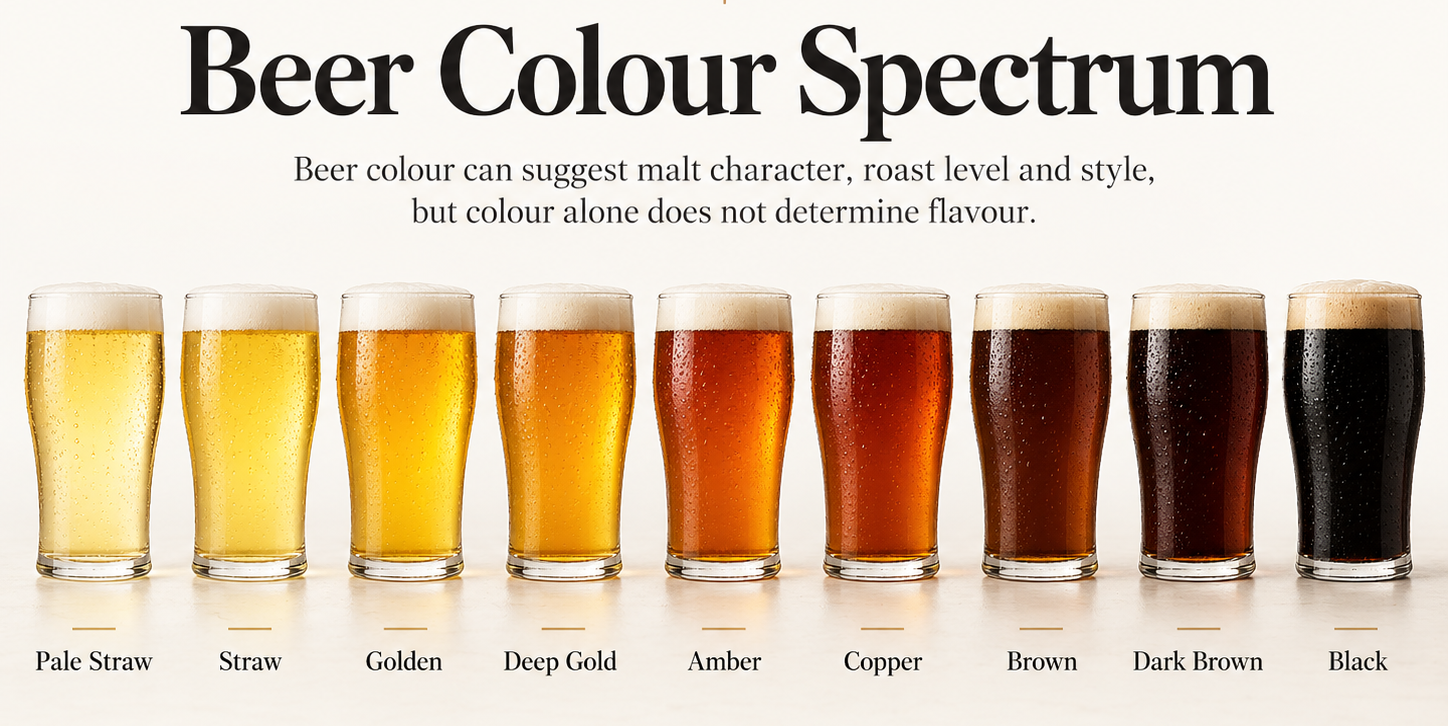
Beer colour spectrum
Use this simple colour palette as a visual reference. Actual beers vary with the glass, lighting, clarity and thickness of the sample.
Pale straw → straw → gold → deep gold → amber → copper → brown → dark brown → black
| Colour | What it might indicate | Examples of beer styles |
|---|---|---|
| Pale straw / straw | Often made with lightly kilned malt; flavours may be delicate, grainy or crisp. | Light lager, pilsner, some alcohol-free lagers |
| Golden | Can suggest a slightly fuller malt presence, with bread, biscuit or honey-like impressions. | Golden ale, blonde ale, wheat beer |
| Deep gold | May accompany richer malt character, although hops and yeast can dominate the flavour. | Pale ale, some IPAs, stronger golden lagers |
| Amber | Darker kilned or speciality malts may contribute biscuit, toffee or caramel-like notes. | Amber ale, some bitters, amber lager |
| Copper / reddish brown | Can reflect darker or crystal malts, sometimes with toasted, caramel or nutty character. | Red ale, bitter, some brown ales |
| Brown | May point towards chocolate, nutty, toasted or lightly roasted malt character. | Brown ale, porter, dark lager |
| Dark brown / black | Often involves dark or roasted malts, which can bring coffee, cocoa or roast notes — but not necessarily heaviness. | Stout, porter, schwarzbier |
How to judge colour in the glass
Hold the beer in a clean, clear glass against a white background in good natural light. Look through the main body of the liquid rather than judging only the darker-looking edges. Describe what you see using straightforward words such as pale gold, amber, copper or deep brown. Also note whether the beer is clear, hazy or opaque — clarity is separate from colour. Finally, look at the foam: its shade, texture and how it clings to the glass can add useful detail to a tasting note.
A note on colour scales: Professional brewers use colour measurements such as EBC (European Brewery Convention) and SRM (Standard Reference Method). The palette above is illustrative, not a calibrated EBC or SRM chart, so it should not be used to assign a precise colour value.
Does beer temperature matter?
It certainly can. Very cold beer is refreshing but can mute aromas and flavours. As it warms slightly, malt, fruit, hop and roasted notes often become easier to identify. There is no single perfect temperature for every beer; treat the ranges below as practical starting points rather than strict rules, and follow any brewery guidance on the pack.
| Beer style | Suggested starting range | Why? |
|---|---|---|
| Light lager / pilsner | 3–6°C | Preserves crispness and refreshing carbonation. |
| Wheat beer / weissbier | 5–8°C | Balances freshness with yeast-derived fruit and spice. |
| Pale ale / session ale | 6–10°C | Allows subtle malt and hop aromas to emerge. |
| IPA / hazy IPA | 7–10°C | Helps reveal citrus, tropical fruit, floral or resinous hops. |
| Porter / stout / dark ale | 9–13°C | Often makes coffee, cocoa and toasted notes easier to perceive. |
| Fruit / sour beer | 5–9°C | Retains brightness without completely hiding fruit character. |
For a simple comparison, try the same beer straight from the fridge and again after a few minutes in the glass. You may notice new aromas as the temperature rises. Do not leave opened beer sitting so long that it becomes flat.
How to smell and taste beer
A consistent order makes the process easier, especially when comparing two similar beers. Give yourself time to notice each stage before reading the marketing description on the can.
Pour it
Use a clean glass. Tilt it about 45 degrees to begin, then straighten as you pour to create a modest head. Note how lively the bubbles are and whether foam lasts. For naturally cloudy or yeast-containing beers, check any pouring instructions on the label.
Look at it
Hold the glass against a light or white background. Is the beer straw-coloured, golden, amber, brown or nearly black? Is it brilliantly clear, hazy or opaque? Is the head fine and creamy, fluffy, short-lived or absent?
Smell before swirling
Bring the glass towards your nose and take one or two gentle, short sniffs. What do you notice first: citrus, grain, bread, flowers, tropical fruit, coffee or something else? Don’t force yourself to name an aroma immediately.
Swirl and smell again
Gently swirl the glass to release more aroma and repeat with short sniffs. Try smelling both close to the rim and a little further away. Pause between sniffs; your nose can become accustomed to persistent aromas.
Take a small sip
Let the beer move naturally around your mouth before swallowing. Notice the initial sweetness, acidity and bitterness, followed by grain, malt, hop, fruit or roasted flavours. There is no special sweet or bitter zone on your tongue.
Notice the mouthfeel
Does it feel light and watery, rounded, smooth, creamy or full-bodied? Is carbonation soft, sparkling or sharp? Does it dry your mouth or leave a coating? These sensations are different from flavour.
Follow the finish
After swallowing, notice what remains. A crisp lager may finish clean and quickly; an IPA may leave lasting bitterness; a stout may leave cocoa or roast. Consider whether the finish is short, medium or long.
Make a second pass
Take another sip after the beer has warmed slightly. Check whether your first impressions change. Ask whether the flavours work together and whether this is a beer you would choose to drink again.
What makes alcohol-free beer different? Without the same amount of alcohol, some beers may have a lighter body or different balance between sweetness, bitterness and acidity. Others use their ingredients and brewing methods to create plenty of texture and flavour. Assess what is actually present rather than judging every example against an alcoholic equivalent.
Beer flavour profiles: a practical reference
Beer aromas and flavours can come from malted grains, hops, yeast, fermentation and added ingredients. These descriptions are common associations, not rules: one IPA may be intensely tropical while another is herbal and bitter, and not every stout tastes of coffee.
| Flavour family | Common descriptions | Often found in | What to look for |
|---|---|---|---|
| Grainy & bready | Fresh bread, cracker, biscuit, cereal, dough | Lagers, pilsners, pale ales, wheat beers | Gentle cereal aromas, biscuit-like malt sweetness |
| Sweet & caramelised | Toffee, caramel, honey, brown sugar, treacle | Amber ales, bitters, dark ales | Richer malt sweetness and rounded character |
| Citrus | Lemon, lime, grapefruit, orange peel | IPAs, pale ales, hop-forward lagers | Bright hop aroma, zest-like bitterness |
| Tropical fruit | Mango, pineapple, passion fruit, guava | Hazy IPAs, modern pale ales | Juicy-smelling hops; not necessarily actual sweetness |
| Orchard & stone fruit | Apple, pear, peach, apricot | Some ales, IPAs, wheat beers | Fruit notes from hops, yeast or additions |
| Floral & herbal | Flowers, grass, herbs, tea, fresh-cut hay | Pilsners, traditional ales, some IPAs | Delicate, fresh or perfumed aromatic character |
| Piney & resinous | Pine needles, evergreen, resin | West Coast-style IPAs, hoppy pales | Assertive hop aroma, potentially firm bitterness |
| Spicy & yeasty | Clove, pepper, banana, bubblegum | Wheat beers, Belgian-style ales | Fermentation character rather than added spice |
| Roasted & toasted | Coffee, cocoa, dark chocolate, toast | Stouts, porters, dark lagers | Roasted grain flavours, sometimes dry or bitter |
| Nutty & earthy | Hazelnut, walnut, woodland earth, woody notes | Brown ales, porters, some traditional ales | Subtle malt or hop depth beneath other flavours |
| Tart & acidic | Lemon sharpness, yoghurt-like tang, green apple acidity | Sour ales, fruited sour beers | A deliberate tang or puckering acidity in suitable styles |
| Smoky | Wood smoke, smoked grain, bonfire | Smoked beers and certain speciality dark beers | Distinct smoky malt character, where intended |
When a flavour seems unusual
Not every unfamiliar flavour is a fault. Some styles deliberately have sour, spicy, cloudy or earthy characteristics. However, strong butter or butterscotch notes (diacetyl), damp cardboard or papery flavours (oxidation), and unpleasant cooked-vegetable or solvent-like notes can suggest a brewing, storage or packaging issue. Context matters, so avoid assuming something is defective from one descriptor alone.
Beer tasting words and what they mean
You do not need a complicated vocabulary. The most useful descriptors are the ones that accurately describe your experience. This quick glossary is a starting point.
Putting your tasting notes together
I find it helps to write down first impressions before deciding whether I actually like the beer. A description such as “pale gold, light citrus aroma, delicate malt sweetness, lively bubbles and a clean, slightly bitter finish” says far more than simply calling something good or bad.
A simple tasting-note template
- Beer: name, brewery, style and ABV
- Appearance: colour, clarity and head
- Aroma: first impressions, then anything noticed after swirling
- Taste: sweetness, bitterness, acidity and recognisable flavours
- Mouthfeel: body, texture and carbonation
- Finish: what remains, and for how long
- Overall: balance, character and whether I would choose it again
If you are tasting with friends, try covering the labels and comparing notes before revealing the beers. People often pick up different aromas, and there is no requirement to agree. That is part of what makes tasting interesting.
One last thought. Your tasting notes are a record of your own senses, not a test with right or wrong answers. You may love a light, uncomplicated lager as much as a complex stout, and there is nothing wrong with that. The aim is to pay attention, build a vocabulary that feels natural and enjoy discovering more about alcohol-free beer.